Build equipment models instead of copy-pasted tag folders.
This skill helps the AI design UDTs that can survive real projects: parameters, nested members, alarms, expressions, event scripts, and Perspective-friendly discovery patterns.

Why it was made
- Pushes parameterized UDT types instead of hardcoded device paths.
- Covers inherited members, overrides, alarms, expression tags, and tag events.
- Warns against blindly mirroring PLC UDTs or forcing one-off tags into a reusable type.
- Supports dynamic Perspective pages that discover equipment instead of duplicating views per device.
Common use cases
- Pump, valve, motor, tank, skid, and instrument models.
- Faceplate contracts and equipment-list screens.
- Reusable alarm metadata, runtime counters, and maintenance counters.
- Deciding when a UDT is useful and when a simpler tag folder is clearer.
- Refactoring copied tag folders into a maintainable model.
Proof style
Validate the artifact, not the promise.
The skill expects readbacks of parameters, member values, expression quality, and runtime alarm paths before promoting a pattern. It does not treat a PLC structure as a good Ignition UDT automatically.
Evidence
UDT planning proof
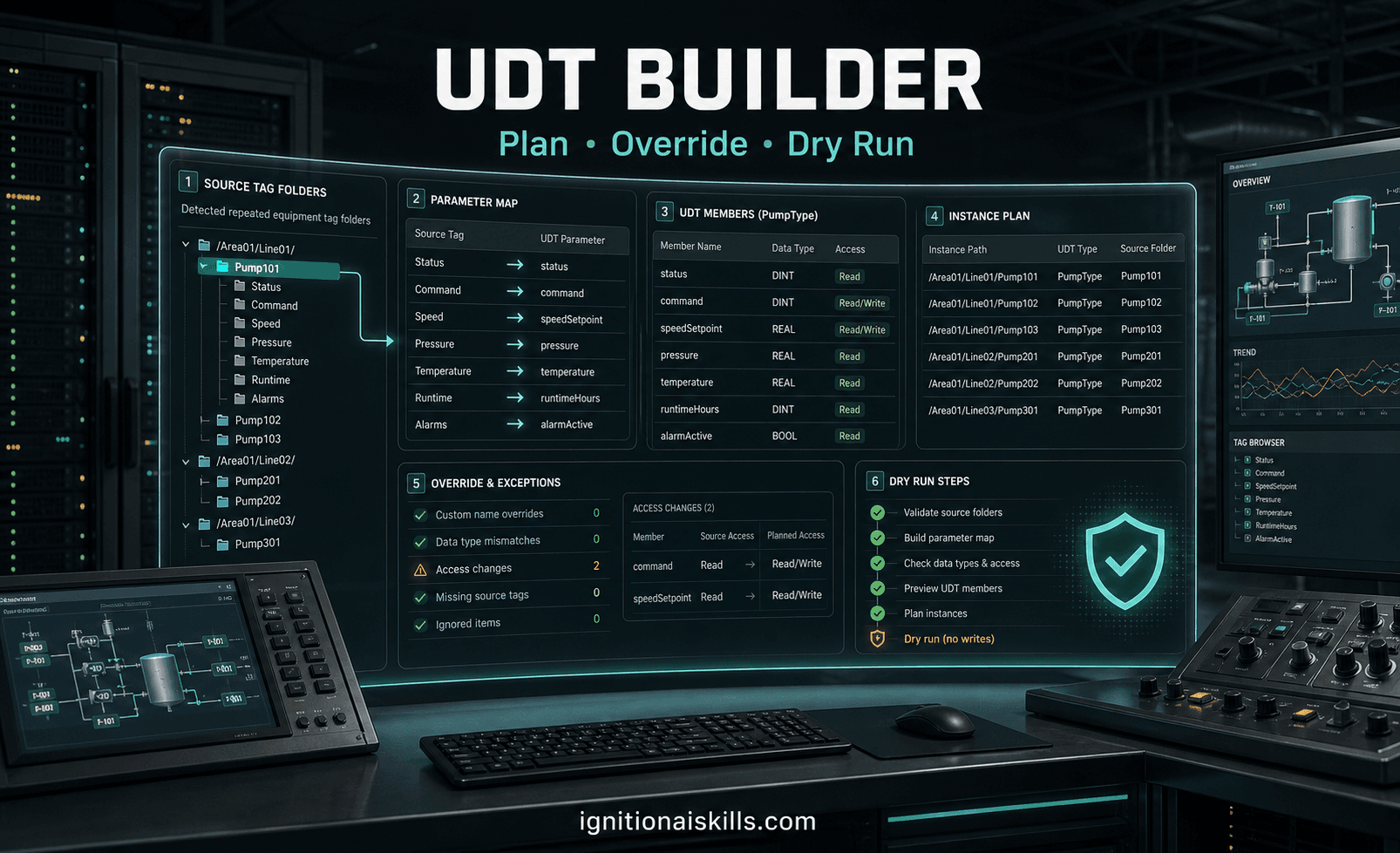
The graphic is AI-generated for the site. The checks below come from a sanitized runner pass that proved the UDT workflow can discover tag providers, browse UDT and tag structure, create a no-write scaffold plan, and reject a missing required override before any write. This is planning evidence, not production migration approval.
- health confirmed tagProviders, tagBrowse, tagRead, tagConfigure, and udtScaffold are supported runner actions.
- tagProviders and tagBrowse found available providers plus UDT definition and test folders without hardcoding reusable paths.
- udtScaffold dry-run planned one UDT type, two instances, four members, required member overrides, and four guarded configure steps.
- Each dry-run step returned ok with zero tag conflicts and the runner reported that no tags were changed.
- A negative dry-run rejected an instance missing the required override before any write path could be used.
Example prompt
Design a reusable PumpCore UDT with parameters, PV/status members, alarm metadata, and faceplate helpers.This is the kind of focused instruction the skill is designed to make useful. The value is in the checks and Ignition-specific defaults the AI uses after reading the skill.
Expected output
- Defines UDT type location, parameters, members, alarms, and instance structure.
- Uses UDT-safe expression patterns like relative paths and typed parameters.
- Lists validation checks for member values, quality, alarm paths, and Perspective bindings.
Related workflows
Skills that pair with this one
Ignition Web Dev API builder
Ignition 8.1Web Dev API Builder
Let the AI inspect, apply, and validate on a Gateway.
Ignition expression builder
Ignition 8.1Expression Builder
Write valid bindings, tags, states, and quality checks.
Ignition HMI SCADA styling
Ignition 8.1HMI/SCADA Styling
Make generated screens readable for operators.
Lifetime membership
Want access to this skill?
The one-time membership unlocks this skill, the full Ignition AI Toolkit, the Web Dev runner materials, setup docs, and versioned Ignition 8.1 and 8.3 downloads.
No subscription. Lifetime members keep portal access to the current toolkit and future skill releases, including planned Ignition 8.3-focused skills as they are added.