Before You Renew Another Six-Figure Manufacturing Software Stack, Run the Agentic Build-or-Buy Test
AI agents have lowered the cost of building a focused internal tool. They have not removed the cost of security, uptime, protocol expertise, deterministic control, or long-term ownership.
Key takeaways
- Feature use and license use are often concentrated, but the popular claim that manufacturers use only 2 percent of purchased features is not supported by credible current evidence.
- The strongest internal-tool candidates are narrow workflows with known users, supported data interfaces, measurable value, and a safe fallback.
- A convincing prototype does not replace protocol expertise, deterministic timing, security engineering, disaster recovery, or years of compatibility work.
- Three-year ownership cost matters more than the speed of the first AI-generated version.
Related product pages
AI changed the cost of the first version
Most plant software stacks accumulated one department at a time. Maintenance bought one platform, quality bought another, and the remaining gaps stayed in paper, email, text messages, and spreadsheets.
A small team can now use a coding agent to build a focused interface, API client, database query, test suite, and operating notes much faster than before. That makes a narrow local workflow worth reconsidering at renewal time.
The first version is only one line in the cost model. Hosting, permissions, monitoring, backups, upgrades, cybersecurity, support, and staff turnover continue after the agent stops coding.
Software use is concentrated, but avoid the 2 percent myth
There is no credible current evidence that manufacturers use only 2 percent of the features they buy. A better-supported conclusion is that daily use is concentrated and many assigned licenses sit idle.
Pendo reported that 6.4 out of every 100 measured features generated 80 percent of click volume in its 2024 product benchmarks. That does not prove the other features had no value. It shows how much activity can collect around a small part of a product.
Zylo's 2026 SaaS Management Index reported an average of 36 percent of provisioned licenses unused. Both figures come from vendor research, so treat them as directional evidence rather than an independent audit of your plant.
Manufacturers are building the missing workflow layer
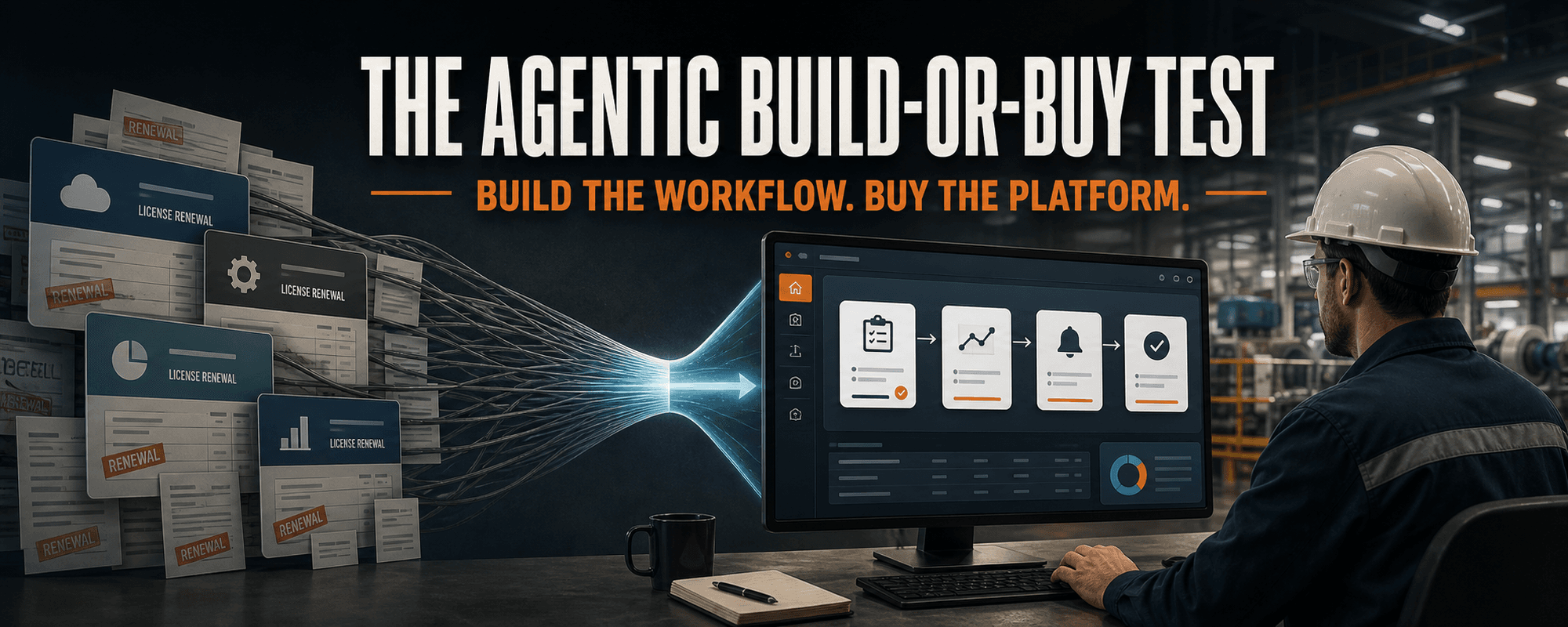
The useful pattern in published customer cases is not wholesale platform replacement. Companies kept the enterprise system and built smaller workflows around it.
Kao
Microsoft reports that Kao replaced more than 300 paper raw-material cards at one factory with an internal app. The first workflow saved about 480 work hours per month, and the program later expanded to more than 260 apps across 10 plants.
John Cockerill
John Cockerill kept SAP as its enterprise system and added smaller time-entry and approval apps. Microsoft reports almost $200,000 in annual savings.
Fortune 100 manufacturing and aviation company
A Capgemini customer story reports 17,000 internal low-code solutions and a $39,000 monthly reduction in licensing expense after modernization.
Good candidates are usually narrow and boring
A good internal tool has a known group of users, a workflow that fits in a paragraph, supported interfaces to approved systems, and a result you can measure. If it fails, the plant retains a safe way to work.
- Downtime capture and escalation
- Shift handoff
- Maintenance planning queues
- Quality checklists
- Work instructions for one line
- Spare-parts search
- Engineering calculators
- Historian, ERP, and quality dashboards
- Reports that replace repeated spreadsheet work
Keep buying the industrial spine
A production driver is not code that worked in a demo. It must handle protocol details, routing, data types, reconnection, firmware differences, security, quality reporting, load, and interoperability over years of operation.
The same boundary applies to deterministic control and enterprise infrastructure. A generated interface can look complete while the permissions model, audit history, recovery plan, upgrade path, monitoring, and support operation remain missing.
- ControlLogix, EtherNet/IP, Modbus, OPC UA, and other production protocol stacks
- Generic industrial edge connectors that buffer and normalize data
- PLC runtimes, safety logic, motion, interlocks, and deterministic control
- Enterprise identity, cryptography, databases, and message brokers
- MES, ERP, QMS, CMMS, and other systems of record
- Enterprise SaaS that requires multi-tenant security and 24/7 support
Run this six-question test before you build
- 01Can the team describe the workflow, users, inputs, outputs, and owner clearly?
- 02Can the tool consume data through a supported API, OPC UA, MQTT, or another approved interface without replacing the communications layer?
- 03Does the plant have a safe fallback if the tool stops working?
- 04Can the team test it outside production and verify the result with logs, readbacks, and human review?
- 05Does it still save substantial money after three years of hosting, maintenance, security, support, and staff time?
- 06Can someone explain, troubleshoot, and maintain it after the original builder leaves?
Cheap code still needs an operating standard
AI has made code cheaper. Plant knowledge, protocol expertise, change control, and long-term ownership are still engineering work.
The strongest rule from the evidence is simple: buy the industrial spine and build the workflow around it. Own only the software that gives the operation a clear advantage and that the team is prepared to support.
Article FAQ
Frequently asked questions
Can an AI agent replace an MES or SCADA platform?
A coding agent can help build a narrow application around supported interfaces. Replacing a production MES, SCADA platform, protocol driver, or system of record requires architecture, security, interoperability, migration, recovery, support, and operating history that a prompt does not provide.
What manufacturing tools are safest to build first?
Start with a bounded workflow such as a handoff form, planning queue, checklist, calculator, report, or dashboard. Use approved data interfaces, keep a safe fallback, and choose a result that can be measured.
How should a team calculate build-versus-buy cost?
Include at least three years of hosting, maintenance, security work, backups, monitoring, upgrades, support, documentation, and staff time. Compare that ownership cost with the license and the business value, not only with the speed of the prototype.
Where should an LLM sit in an industrial system?
Keep it outside deterministic and safety-critical control paths. Use deterministic code and controls for bounded timing and safety behavior, with AI assisting research, authoring, analysis, testing, or human-reviewed workflows.
Sources and notes
Documentation referenced
- Original X article by RudyIndustrialAutomation
- Pendo 2024 Product Benchmarks
- Zylo 2026 SaaS Management Index
- Microsoft customer story: Kao internal apps
- Microsoft customer story: John Cockerill
- Capgemini customer story: manufacturing and aviation low-code modernization
- ODVA EtherNet/IP technology overview
- OPC Foundation certification program
- NIST Secure Software Development Framework
- FDA Computer Software Assurance guidance
Lifetime membership
Want the toolkit behind this workflow?
The one-time Ignition AI Toolkit membership includes the Web Dev API runner, skill files, setup docs, versioned downloads, and released Ignition 8.3 resources for lifetime members. Founder pricing is available while the first 50 spots last.
Founder lifetime access - $99