The AI Agent Workflow Manufacturing Can Actually Use
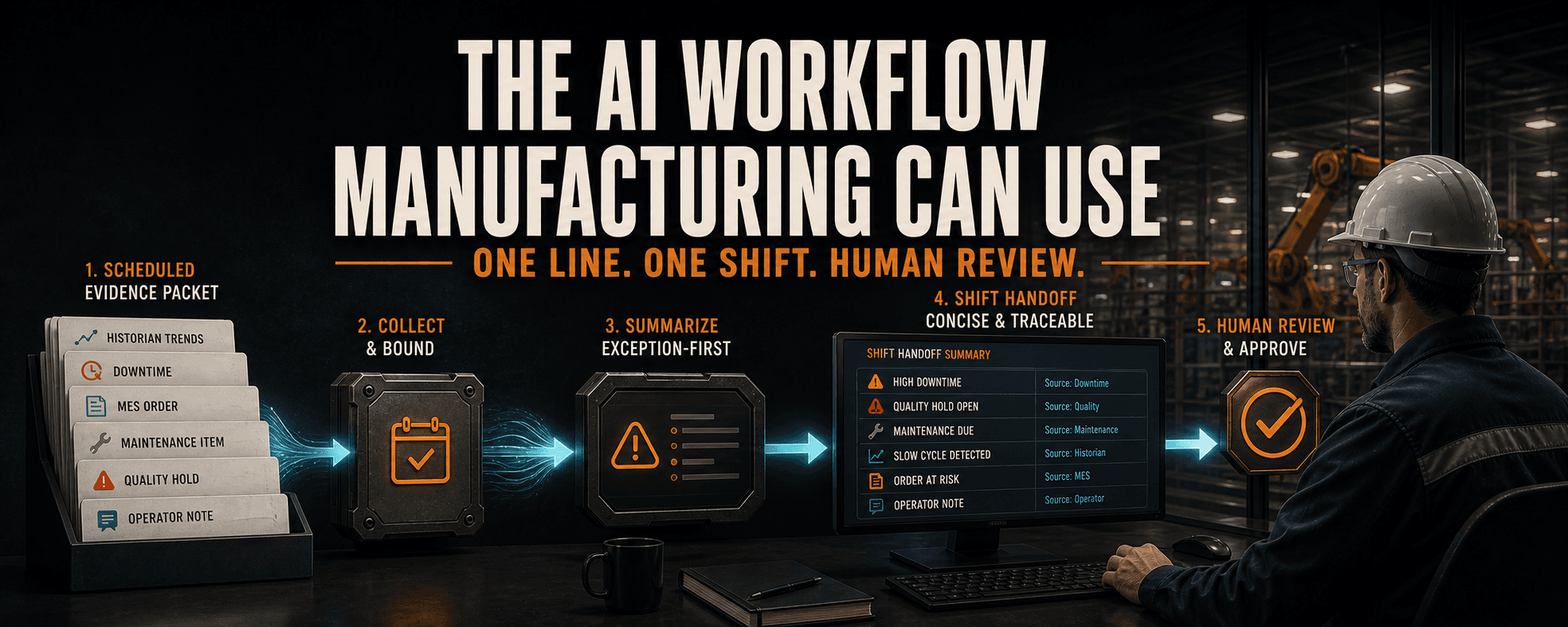
A practical first manufacturing agent is one scheduled job with approved data sources, a fixed shift-handoff output, traceable statements, and a supervisor responsible for approving the result.
Key takeaways
- Begin with one scheduled job, approved data sources, a fixed output, and a named reviewer.
- The model should not decide which systems to search or how far back to look.
- Every operational statement should link back to a plant record, and missing context should remain visible.
- Track preparation time, source coverage, edit rate, unsupported statements, missed events, and follow-up closure.
- Keep the first version away from production writes, work-order creation, setpoints, and control commands.
Related product pages
Manufacturing does not need an open-ended first agent
Manufacturing does not need an open-ended AI agent searching through every plant system and deciding what matters. A better first project is smaller: one scheduled job, approved data sources, a fixed output, and a person responsible for approving the result.
A shift-handoff agent is a practical place to start.
Start with one line and one shift
Twenty minutes before shift change, a scheduled job collects a fixed evidence packet for one production line.
The line, time window, systems, and allowed fields are configured in advance. The language model does not decide which databases to search or how far back to look.
- Historian trends and production counts
- Equipment-state intervals and downtime reasons
- Active orders from the MES
- Open maintenance work from the CMMS
- Quality holds and inspection exceptions
- Operator notes
Give the agent a narrow writing job
The agent reviews the approved evidence and drafts an exception-first handoff that answers five questions.
The outgoing supervisor reviews and edits the draft. Only the approved version is saved in the operations log or MES note.
The agent helps assemble the record. It does not become the system of record.
- What changed during the shift?
- What affected production, quality, or maintenance?
- What is still unresolved?
- What should the next shift inspect first?
- Which plant record supports each statement?
Make every statement traceable
If the draft says Line 2 had a long stop, the supervisor should be able to open the equipment-state interval, see the recorded reason, identify the active order, find the related maintenance item, and confirm when production resumed.
Missing context should remain visible. A downtime interval with no reason, an operator note with no asset, or a quality hold with no order number should be marked incomplete. The agent should never replace a missing field with a convincing guess.
Measure whether it is actually helping
These numbers tell you whether the handoff is becoming faster, more complete, and easier to review. They do not give the agent more authority.
- Handoff preparation time
- Required source coverage
- Supervisor edit rate
- Unsupported statements
- Important events the draft missed
- Follow-up items closed by the next shift
Keep the first version read-only
The first version should not create work orders, change MES records, write to the Gateway, issue production commands, or modify setpoints.
Any future write action should use a separate identity, an allowlisted workflow, validation, human approval, and an audit record. Production control should remain outside the agent.
Run a four-week pilot
- 01Week 1: Choose one line, one shift, the exact source fields, and a fixed handoff format.
- 02Week 2: Run the agent in shadow mode beside the current handoff process.
- 03Week 3: Let supervisors review the draft and its evidence links inside the normal handoff screen.
- 04Week 4: Review the measurements and decide whether to keep, revise, or stop the pilot.
- Every operational exception can be traced to a plant record.
- Unsupported statements never reach the approved handoff.
- The agent has no production-control authority.
Adapt the structure, not the permissions
If the pilot works, the same structure can be adapted for condition-based work-order drafts, quality-exception reviews, or SOP-guided troubleshooting. Each use case still needs its own approved sources, permissions, review step, validation, and measurements.
Practical AI Foundations and Ignition AI Skills
I am building both the course and Ignition AI Skills.
Practical AI Foundations is for manufacturing professionals who want to learn useful prompting, verification, AI workflows, and implementation boundaries. Join the courses waitlist to hear when it opens.
The Ignition AI Toolkit provides separate Ignition 8.1 and 8.3.8 guidance for Jython, Perspective, Vision, expressions, UDTs, SQL, and bounded Gateway workflows. It is designed to reduce common errors and repeated example-pasting, but the engineer still reviews and validates the result on the Gateway.
Article FAQ
Frequently asked questions
What is a practical first AI agent workflow for manufacturing?
A bounded shift-handoff agent is a practical start. Give it one line, one shift, approved data fields, a fixed output, traceable evidence, and a supervisor who approves the final record.
What data should a shift-handoff agent use?
Use a configured packet such as historian trends, production counts, equipment-state intervals, MES orders, CMMS work, quality exceptions, and operator notes. Do not let the model decide where to search.
How do you measure whether the manufacturing AI workflow helps?
Track preparation time, required source coverage, supervisor edit rate, unsupported statements, missed important events, and whether the next shift closes the follow-up items.
Should the first manufacturing AI agent write to production systems?
No. Keep the first version away from work-order creation, MES changes, Gateway writes, setpoints, and production commands. Any later write needs its own identity, allowlist, validation, approval, and audit record.
Sources and notes
Documentation referenced
Lifetime membership
Want the toolkit behind this workflow?
The one-time Ignition AI Toolkit membership includes the Web Dev API runner, skill files, setup docs, versioned downloads, and released Ignition 8.3 resources for lifetime members. Founder pricing is available while the first 50 spots last.
Founder lifetime access - $99