Ignition 8.3.8 Moves to Jython 2.7.4: What Actually Changes for Scripts and AI Agents
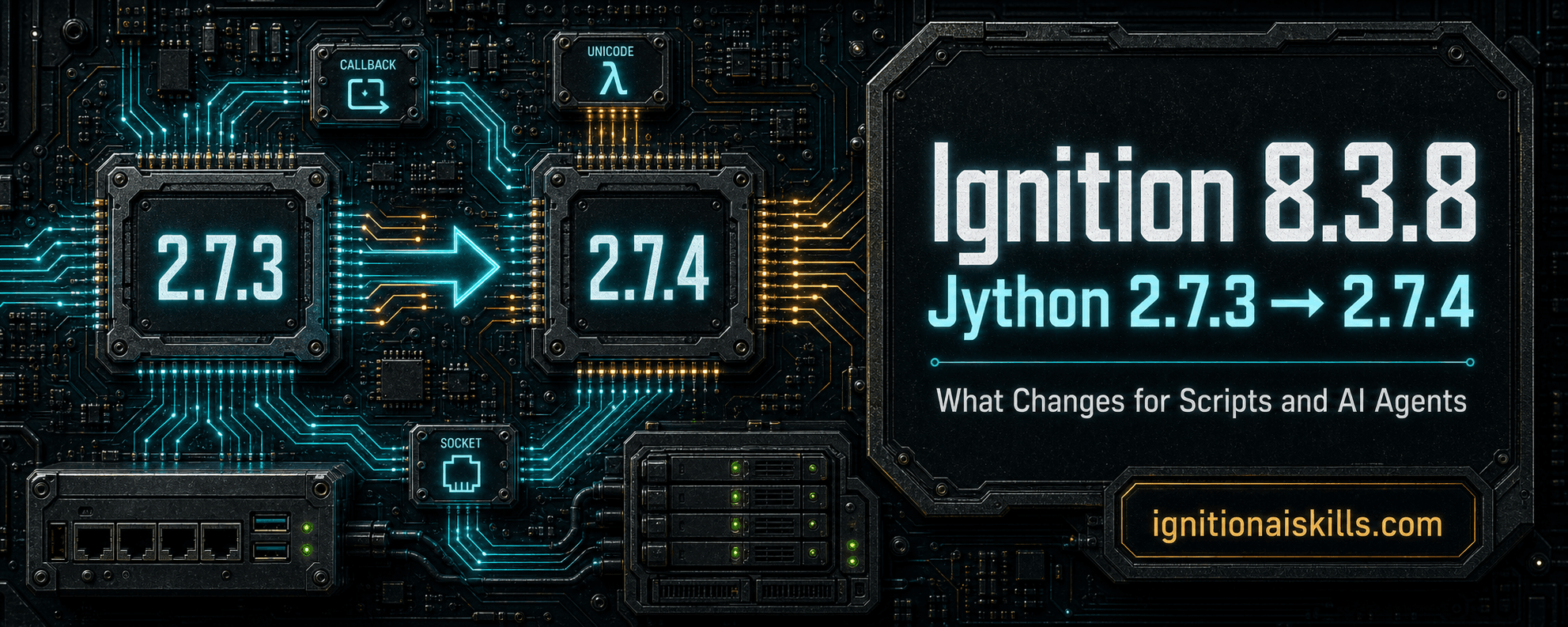
Ignition 8.3.8 updates its embedded interpreter to Jython 2.7.4. You do not get new Python syntax, but Java overloads, callbacks, Unicode characters, sockets, and several embedded-runtime behaviors become more dependable.
Key takeaways
- Normal system.* scripts should require little or no rewriting.
- Java-heavy projects get the most value from the upgrade.
- Java fixed-arity overloads now take precedence over compatible varargs overloads, including constructors.
- More modern Java functional interfaces can accept Python functions as callbacks.
- A Java char now maps to Python unicode, which fixes non-byte characters but can change type checks.
- Raw socket Unicode sending is repaired, though explicit encoding is still the safer production pattern.
- Jython remains Python 2.7 and still cannot use ordinary CPython C-extension packages such as NumPy or pandas.
- AI agents need a version-aware Ignition 8.3.8 profile plus targeted regression tests.
Related product pages
First, what this upgrade is not
Jython’s own project page is explicit: the current 2.7.x release supports Python 2, while Python 3 work is separate. Ignition 8.3.8 therefore still needs Python 2.7-compatible code.
The same rule applies to async def, await, type annotations, structural pattern matching, dataclasses, and other Python 3 features. Jython 2.7.4 also does not make CPython native extensions available. Pure-Python 2.7-compatible code and Java libraries remain the realistic extension paths.
There is also no reason to expect a blanket performance improvement. Upstream describes 2.7.4 mainly through specific fixes, dependency updates, and Java modularity support—not a general speed claim.
# Valid Python 2.7 syntax
logger.info("Count: %d" % count)

# Still invalid in Ignition's Jython runtime
logger.info(f"Count: {count}")The biggest change: more correct Java overload selection
This is the upgrade’s most important behavior change for advanced Ignition scripting.
In Jython 2.7.3, obj.update(1, 2) could incorrectly choose the varargs method. Jython 2.7.4 prefers the compatible fixed-argument method, matching the expected Java behavior. The same correction applies to overloaded constructors.
That matters when a script calls custom Ignition modules, vendor SDKs and Java database libraries, Java networking or utility libraries, exception constructors with several signatures, or any API that exposes both fixed and varargs forms.
This opens a cleaner direct-Java workflow. An AI agent can inspect a library’s signatures, choose the intended call, and test the returned Java type without immediately requiring a wrapper method to avoid Jython’s old dispatch bug.
There is one migration risk: code that accidentally depended on the wrong 2.7.3 overload may behave differently after the upgrade. Treat the new result as a correction, but regression-test critical Java calls instead of assuming they are equivalent.
void update(int first, int second)
void update(int... values)Python functions work with more modern Java callbacks
Jython can adapt a Python function to a Java interface with one abstract method. In 2.7.3, that conversion could fail when the interface also contained Java default methods. That affected interfaces such as java.util.function.Consumer, whose abstract accept() method is accompanied by the default andThen() method.
Jython 2.7.4 fixes that suitability check. For Ignition, this improves workflows involving Java collections, third-party library callbacks, and APIs built around modern functional interfaces. It can also reduce adapter boilerplate in agent-generated integrations.
The fix does not make threading concerns disappear. A Java API may invoke the callback on a background thread. Perspective session objects, Vision components, and other scope-sensitive objects do not become safe merely because callback registration succeeds. An AI agent still needs to identify execution scope, thread ownership, and the allowed way to return work to the UI or Gateway.
from java.util import ArrayList

values = ArrayList()
values.add("Mixer-101")
values.add("Mixer-102")

received = []

def collect(value):
    received.append(value)

values.forEach(collect)Java char values now arrive as Python unicode
Jython 2.7.3 adapted Java char values to Python byte strings. That failed when a character’s numeric value was above the byte range.
One upstream report used Java locale formatting. Some locales use a non-breaking space or another non-ASCII character as the grouping separator. In 2.7.3, retrieving that character could raise Cannot create PyString with non-byte value. The merged 2.7.4 fix maps Java char to Python unicode instead.
That makes localized formatting, international text, and some Swing/Vision interactions more dependable. It also introduces the most visible type-level compatibility change in this release. Use basestring when the Java-returned value may be either Python 2 string type, and encode only when crossing a byte boundary.
from java.text import DecimalFormat

symbols = DecimalFormat.getInstance().getDecimalFormatSymbols()
separator = symbols.getGroupingSeparator()

# Correct for either Python 2 string type
isinstance(separator, basestring)

# Encode only at a byte boundary
payload = unicode(separator).encode("utf-8")Unicode sockets work again, with one important caveat
Jython 2.7.3 introduced a regression in raw socket.send() and socket.sendall() when passed a Unicode object. Jython 2.7.4 repairs the path by encoding the Unicode value before it reaches the byte-buffer operation.
That helps custom TCP clients, device protocols, and small Gateway integrations built directly on Python’s socket module. It does not affect ordinary calls through Ignition’s HTTP client APIs.
For production protocols, continue to encode explicitly so the wire format is unambiguous. The upgrade makes a previously broken case work; it does not remove the need to define an encoding with the system on the other end.
message = u"Temperature: 23 °C\n".encode("utf-8")
connection.sendall(message)Smaller fixes that matter in an embedded Gateway
Jython 2.7.4 also includes several narrower corrections. Most do not create a new Ignition API; they reduce surprising failures in long-running or unusual workloads.
Also keep the boundary clear: Ignition 8.3.8 adds its own system.config namespace and three new system.secrets functions, but those are Inductive Automation features released alongside the Jython bump. They did not come from Jython 2.7.4.
- The Unicode name database is updated to Unicode 15.1 for named escapes.
- xml.parsers and xml.etree are added to xml.__all__ for wildcard imports.
- Warning logic handles an empty sys.argv, a useful embedded-interpreter edge case.
- An interactive syntax error is raised instead of sometimes producing an unnecessary continuation prompt.
- A weak-reference reaper-thread locking failure is fixed.
- Wildcard Java imports are repaired for Java 21.
- Upstream JARs gain better Java 9+ module-path support and refreshed dependencies.
What new workflows does this realistically open?
The best description is fewer workarounds around the Java boundary.
Direct vendor-library integration
Scripts can call overloaded Java APIs with more confidence. This is valuable for custom modules, SDKs, JDBC-adjacent helpers, and protocol libraries.
Functional callback pipelines
Python functions can plug into more Java collection and callback interfaces that use default methods. That can simplify event processing, Java stream-adjacent utilities, and asynchronous library integrations—provided threading is handled deliberately.
Localization-safe industrial applications
Locale symbols and other Java characters no longer fail merely because they are outside a one-byte range. Internationalized reports, labels, numeric formatting, and Vision components become easier to handle correctly.
Cleaner custom protocol clients
Raw socket text can be sent again, while explicit UTF-8 encoding gives the agent a reliable, testable wire contract.
Stronger version-aware agent validation
An agent can now test the exact runtime behaviors that distinguish 2.7.4: overload selection, callback coercion, Unicode character conversion, and socket encoding. Those tests are more valuable than simply changing 2.7.3 to 2.7.4 in a prompt.
What AI agents need to learn
They do not need to learn new syntax. They need a more precise runtime contract.
The agent should also branch on the actual Gateway line. An 8.1 skill should not silently inherit 8.3.8 assumptions, and an 8.3.8 skill should not keep workarounds that existed only because of 2.7.3 bugs.
- 01Target Jython 2.7.4 and Python 2.7 syntax.
- 02Continue blocking Python 3-only syntax and libraries.
- 03Prefer basestring when Java-returned text may be either str or unicode.
- 04Inspect overloaded Java signatures and test which method or constructor was selected.
- 05Allow single-abstract-method callback patterns with Java default methods, but document thread and scope assumptions.
- 06Encode text explicitly before byte-oriented I/O.
- 07Never invent new system.* functions from the interpreter version number.
- 08Verify behavior on a development or staging Gateway before promoting the pattern into a reusable skill.
A focused upgrade test plan
Start by confirming the runtime in the Designer Script Console, then prioritize the behaviors most likely to expose a meaningful change.
Test on a separate Gateway or staging environment before production. For most ordinary Ignition projects the migration risk is low. For projects with deep Java integration, the risk is moderate—not because 2.7.4 is less correct, but because corrected dispatch can reveal code that relied on the old behavior.
import sys
from java.lang import System

print "Jython:", sys.version
print "Java:", System.getProperty("java.version")- 01Custom Java methods with fixed and varargs overloads.
- 02Overloaded Java constructors.
- 03Callbacks using Consumer, BiConsumer, or vendor interfaces with default methods.
- 04Locale code using DecimalFormatSymbols or Java Character values.
- 05Checks that assume a Java-returned character is exactly str.
- 06Raw socket.send() and sendall() calls.
- 07Highly concurrent Gateway scripts and long-running background tasks.
- 08Any agent-generated integration that previously required a Java wrapper.
Article FAQ
Frequently asked questions
Does Ignition 8.3.8 support Python 3 now?
No. Jython 2.7.4 is still a Python 2.7 runtime.
Do my normal Ignition scripts need to be rewritten?
Usually not. Scripts centered on tags, databases, Perspective, Vision, alarms, and ordinary system.* calls should mostly behave the same.
What is the most important compatibility change?
Java overload selection can now choose a different—and normally correct—fixed-argument method or constructor instead of a varargs alternative. Java char values also arrive as unicode rather than str.
Can I use NumPy or pandas now?
No. Jython does not gain support for ordinary CPython C extensions in 2.7.4.
Does an AI agent need a new Jython syntax guide?
No. It needs the same Python 2.7 syntax guardrails plus new interoperability tests and type-handling rules.
Is this a major upgrade?
For everyday scripting, no. For Java-heavy integrations, localization, callbacks, raw sockets, or embedded-runtime edge cases, it is a meaningful correctness upgrade.
Sources and notes
Documentation referenced
- Ignition 8.3 — New in 8.3.8
- Jython 2.7.4 release announcement
- Jython 2.7.4 NEWS file
- Jython project: current 2.7.x supports Python 2
- Jython issue #221: method overload precedence
- Jython issue #281: overloaded constructor selection
- Jython issue #277: Java interfaces with default methods
- Jython PR #293: Java char maps to unicode
- Jython issue #254: Unicode socket regression
- Definitive Guide to Jython: C-extension limitation
Lifetime membership
Want the toolkit behind this workflow?
The one-time Ignition AI Toolkit membership includes the Web Dev API runner, skill files, setup docs, versioned downloads, and released Ignition 8.3 resources for lifetime members. Founder pricing is available while the first 50 spots last.
Founder lifetime access - $99